Oak Ridge National Lab · WORK IMPACTS
How might we uncover the everyday friction that wears employees down?
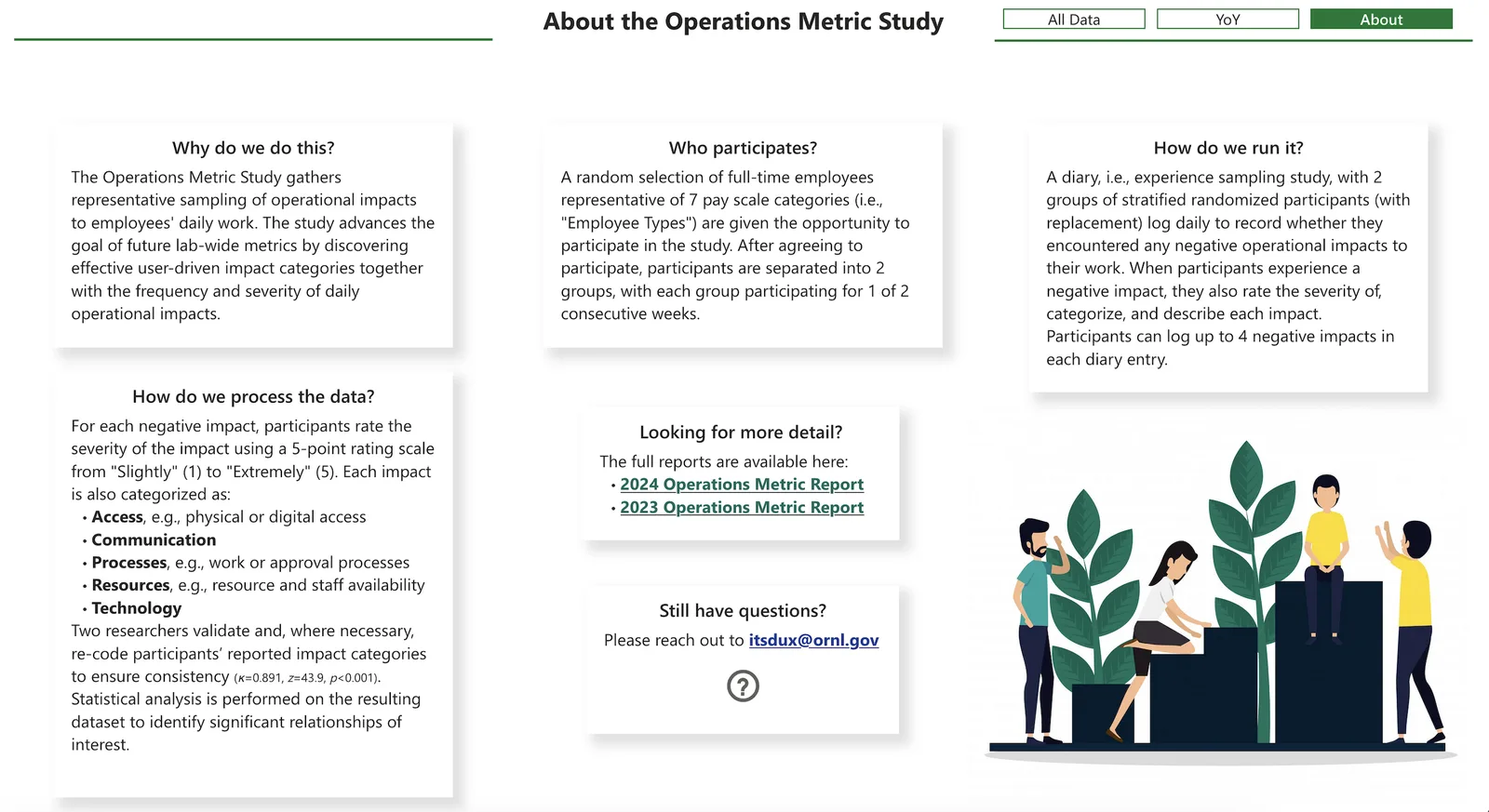
I designed the mixed-methods structure with our qualitative UXR lead, then led the statistical analysis that turned hundreds of open-ended diary entries into patterns IT, Facilities, and People leadership could act on. Sustaining a diary study, arguably the hardest research method to keep running at scale, across multiple annual rounds is what let us tell the difference between a bad week and a systemic problem. That distinction is what lets the study determine which issues receive funding.
BY THE NUMBERS
- 393staff have participated
- 2,000+daily diary logs collected & analyzed
- 817negative daily impacts categorized & reported
- 3presentations to leadership, directly resulting in funding decisions
- DATE
- Summer 2023 -
- ORGANIZATION
- Oak Ridge National Laboratory
- ROLE
- Quantitative research leadStatistical analysisStrategic insight generationLongitudinal program design
- DELIVERABLES
- Longitudinal Operations Metrics diary study program, cleaned and coded diary dataset (>500 entries per round), leadership decks, Power BI dashboard tracking friction points YoY
How was the study developed?
- 01
Longitudinal Diary Study Design
I collaborated with our qualitative UXR lead to develop a repeatable, mixed-method diary study. Participants logged disruptions to their workday, capturing structured data (impact category, severity, resolution) and open-text reflections.
- 02
Mixed Methods Analysis
I led the quantitative analysis, applying ANOVAs, chi-squared tests, and severity scoring, and collaborated with teammates on thematic coding to extract rich patterns across roles and disruption types.
- 03
Cross-Team Leadership Engagement
Findings were regularly shared with IT, Facilities & Operations, and People leadership. Leadership uses the study to decide which operational areas receive funding. Please note that findings are not shareable publicly due to internal sensitivity.
- 04
Year-Over-Year Benchmarking
Our longitudinal structure allowed us to detect stable friction points and new/emerging patterns, enabling ORNL to respond proactively to persistent employee experience issues.
Main Takeaways
Results have been used to improve communication around service delivery, reduce repeated technical barriers, and bring employee voice into strategic operations planning.
Designing and leading a longitudinal, mixed-methods study to surface workplace friction across roles demonstrates my ability to build scalable research systems that drive operational insight and cross-functional alignment in large, complex organizations.
Please note that findings are not shareable publicly due to internal sensitivity.